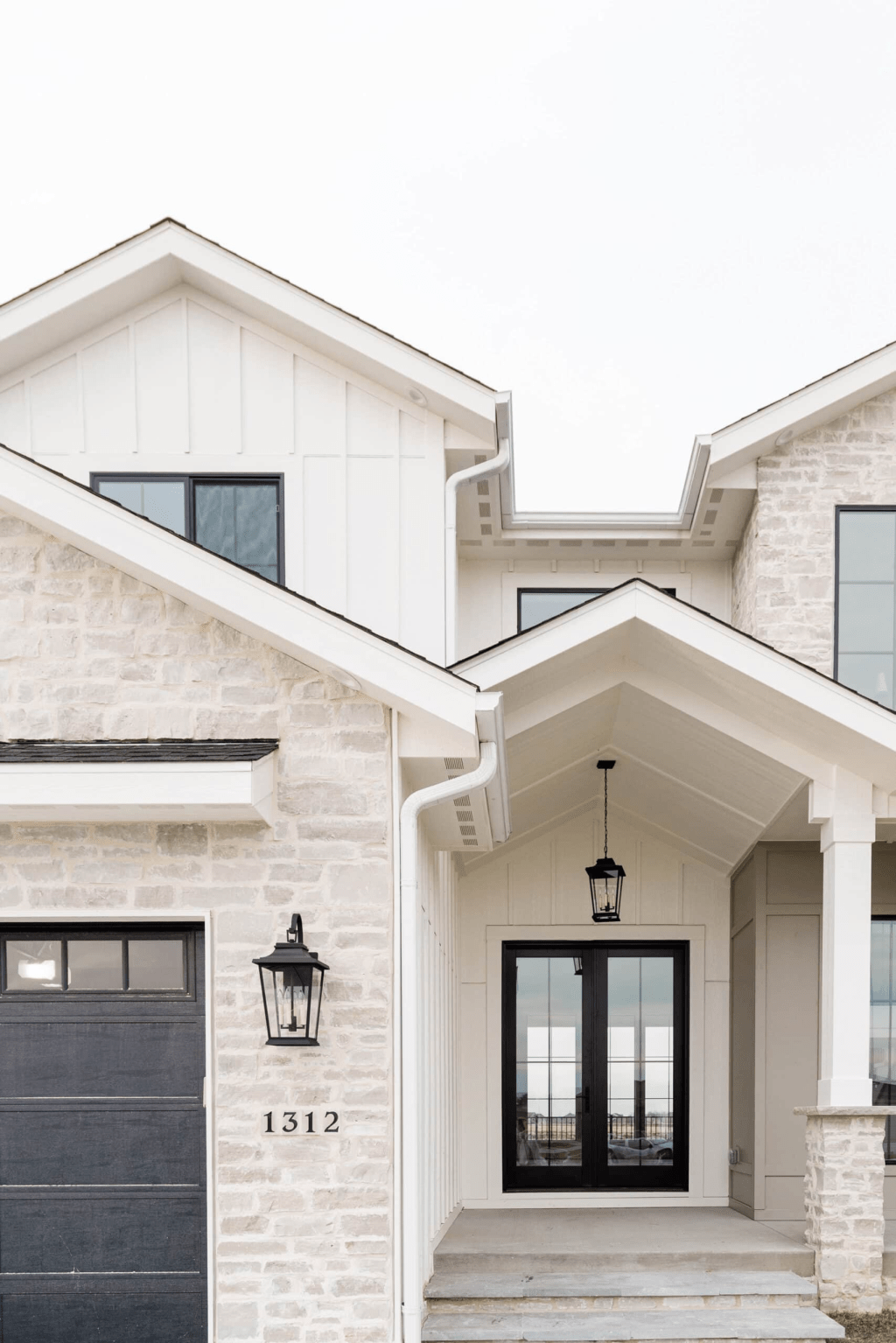
Featured Image: James May Homes
Planning a custom home has already become one of the most fun and exciting projects of my life. I say that as someone engaged and also in the midst of wedding planning! I know that when Brandon and I went down the route of wanting a custom home, it was hard to find information on what to do before you’re ready. I’m a planner, so I wanted to make sure I had everything together before it was time to sign a contract. Below, you’ll find the process we’ve taken so far, what’s coming up, and any advice we have for people in the same boat.
Deciding on a custom home
Building a custom home is not for the faint of heart, but somehow we still ended up here. Our current home (manufactured double wide) is running on borrowed time and has quite a few issues. Our biggest concern is needing more bedrooms, which will be important in a couple of years. It’d be inefficient and expensive to add on more square footage for bedrooms for this particular house, so that’s why we decided not to do an addition or renovation.
As for moving to a different house, that was definitely a possibility. There were a lot of old houses in our area that had massive square footage, but they were lacking in land or room to add a garage. We also wanted the updated, more energy-efficient amenities that come with newer houses.
Finally, we landed on a custom home because a lot of the online floor plans we looked at were close, but knowing this will be our forever home, we wanted it to feel just right. I’d also add on that this was just something we really, really wanted to do. Some people want to go out there and see the world and travel. I just wanted to go out there and create a house that was perfect for us to stay home and make memories in!
Determined our budget
When you get a construction loan, you need 20% down. One part of determining your budget is figuring out how much you can spend on a monthly mortgage payment, another part is deciding how much cash (or equity) you’ll be able to save so you can actually get started. In our case, we wanted to have a monthly payment that felt very manageable, so we fell below the recommended ‘no more than 28% of your gross monthly income should be spent on your mortgage payment’ guideline. I think our absolute max budget (which is 20% higher than the budget we’re aiming for), would put us at just 23% of our gross monthly income (we are factoring taxes/insurance into our payment total).
Determining our budget told us how much cash we had to save up.
Started saving our cash
It’s so important to be on the same page with yourself or with your partner about how much you intend to save each month. Brandon and I knew our monthly goal, we knew that a portion of any tax refunds/bonuses would go towards our down payment, and we knew at X month we should have Y dollars. On one hand it made the process a little boring, on the other hand it kept us accountable.
Found a place to build
Now, if I was me from last year, I would read this step and be confused. What do you mean find a place to build, we’re not ready yet! Knowing where you’re going to build is important because it greatly impacts your design. Some people will say it impacts design due to the lot size/shape, but I’m going even more general and saying it impacts what you can afford to build. It should be no surprise that building in a city or even the outskirts of a city (Des Moines and its ever expanding suburbs) will be more expensive than building in a smaller town or area with a low cost of living. With higher costs of labor comes higher build costs, which leaves less room in the budget for all of the ‘fun’ things. An easy way to see how the prices of new construction varies is by looking at Zillow and filtering on ‘homes’ and ‘max year built XXXX’. Then hop around some different areas and see how the prices change!
Also, lots are expensive. You’ll need to have an idea of how much a lot would cost because that will come out of your build budget unless you already have a lot picked out. If you’re not sure how much lots cost, you can look at Zillow for lots instead of houses. Keep in mind that some lots may be cheaper upfront, but could be more expensive if they’re in an area that hasn’t been developed yet.
We personally decided to build on our existing lot and do a teardown on the existing house. It’s at the end of a wooded looped lane where there’s no traffic, the school and grocery stores are all less than five minutes away. While we briefly considered buying a different lot, I really do love our location. With it comes 3.5 acres of all sorts of wildlife. Plus, I hardly notice the train now!
Played with designs
We had quite the journey with our different floor plans. We started on graph paper (1 square = 1 foot), then Brandon started drawing our plans on draft paper. After a while, we realized that we needed to invest in some technology to make revisions easier and quicker. I had a solid run with an iPad app, but recently took the plunge with SketchUp Pro. While SketchUp Pro was certainly an investment, I have already (in my mind) saved us time and money by making tweaks to what we thought we wanted. I also think it’ll be great down the road with planning out our furniture.
Big disclaimer here, there are tons of great floor plans out there. I would highly encourage starting with those that way you save time and money. The builders we talked to advised against purchasing online plans since they could easily draw up something similar. You’ll see a lot of advice online that says going with a stock plan is less expensive than designing from scratch. We only skipped that route because we weren’t finding exactly what we wanted.
‘Interviewed’ builders
In a city or a town that is having active new construction, this isn’t something you probably need to jump on right away. However our town didn’t have a lot of building activity, and we wanted to make sure our builder was capable of helping us turn a custom floor plan into something buildable (some builders don’t allow customizations!). We started with a builder in Council Bluffs, but ended up with someone a little closer to home. At this point, we had about 50% of our down payment saved and since they were having a steady flow of customers, we got ourselves added to their wait list.
Finished saving our down payment
When we were 95% saved with the down payment (so close!), I happened to see a comment online that said you could use land equity as part of your down payment. I asked a mortgage lender at our bank to confirm and was shocked when they said it was true. With that knowledge (and knowing we were going to need to pay off the existing mortgage anyway before tearing down this house), we used a chunk of our down payment cash to pay off the house. The appraised value of the land (without the house – we’ll tear it down) was almost the amount it took to pay off the house. We saved our down payment as a combination of cash (in the bank), appraised land value, and a little extra cash to get us back to our original goal. Overall, paying off the mortgage extended our down payment savings timeline by just a month, so we felt it was a good decision.
Where we’re at now
Currently we’re saving for the builder’s design fee and will have that ready next month. We’re hoping the builder will reach out in January to start drafting our plans. From February to May, we will be setting aside money for the closing costs on the construction loan. We’re not exactly sure how much it’ll cost, but we’re estimating high and saving roughly 20% of what we saved for our down payment. After that, we’ll continue saving the same amount of money each month to build out our cash contingency fund. This is important for handling any unexpected costs that pop up during the build. Our goal is to start building at the end of 2023 or beginning of 2024. Either way, we think we’ll be in our new house by the end of 2024.
As we know more, I’ll provide more updates. Thanks for reading!
 fluted wood & marble
Leave a comment